

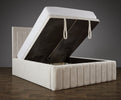
How to Organise the Space Inside an Ottoman Storage Bed
, by RSB Furniture, 8 min reading time
A practical after-purchase guide to sorting ottoman-bed contents by retrieval frequency, fitting removable organisers and keeping the opening accessible.
An ottoman bed can hold more than one type of bedroom item, but a compartment without a plan soon becomes a place where useful things disappear beneath other useful things. The most effective organising system is not the one with the most boxes. It is the one that lets you find and remove what you need without unpacking the whole bed.
This guide starts after the bed has been chosen. It shows how to sort the contents by retrieval frequency, select removable organisers that fit the actual interior and keep the opening clear. Internal layouts and care requirements differ, so use the exact bed and its guidance as the final reference rather than assuming every ottoman base is identical.
Take everything out before buying dividers or deciding that a particular storage box will fit. With the bed open as directed for your model, look at the usable interior: note its base, walls, any internal divisions, fittings and the space occupied by the opening mechanism. A photograph and a quick sketch are useful references when you are later comparing containers.
Measure each genuinely usable section, including its height below the closed top, rather than treating the bed's outside dimensions as an internal measurement. Allow room to take a container out by its handles and to put it back without scraping upholstery or hardware. If the layout is unclear, ask RSB Furniture about the exact bed and selected configuration before committing to a set of organisers. Neither the number of sections nor a storage capacity should be inferred from a styled product photograph.
For example, the Sovereign Bliss scroll bed with storage options is described by RSB with integrated storage compartments and a gas-lift mechanism. The listing does not give you a universal template for where to put containers in every size and configuration. Work from the interior of the bed you actually have.
Make three piles on the floor before anything goes back. Put frequently retrieved items in the first pile: perhaps the spare pillowcases you change regularly or a throw you use most weekends. The second pile is for things brought out every few months, such as bedding for guests. The third is for seasonal or seldom-used items. Set aside anything that belongs elsewhere; storage under a bed need not become the default home for every bedroom overflow item.
Now arrange the categories around the real access point. Give the most accessible area to the first pile. Put occasional items in the next convenient position, and less frequently retrieved items where they can be reached after removing one organiser, not after dismantling a tower. This is a retrieval route, not a fixed rule about front, back, left or right: the useful position depends on how your particular base opens, which side you approach from and any internal division.
A simple test is to ask, “Can I get the spare sheets without moving the winter duvet?” If the answer is no and the sheets are used more often, reverse their positions. This small change matters more than colour-coordinated labels.
Choose containers only after you know the internal layout and the size of the piles. Soft-sided bags, low lidded boxes and fabric organisers can each be useful, but none suits every compartment. A soft bag may adapt to an awkward section; a rigid box may make a small group of items easier to lift out together. Check the container's external dimensions with its lid, seams and handles included, and test it with the bed closed in accordance with your bed's instructions before filling it fully.
Use one organiser for one recognisable group: “guest pillowcases and sheets”, “winter accessories” or “spare throws”. Avoid a single large box labelled “miscellaneous”, which simply relocates the search. Choose a size you can remove conveniently from the available opening, not the largest one that appears to fit on the base. If the shape is irregular, two smaller containers may be easier to manoeuvre than one broad box.
Keep frequently used textiles in a bag or box that can be lifted as a unit. For less frequently used bedding, fold items into one labelled group rather than making several deep layers. The purpose of an organiser is to reduce handling and protect your sorting system, not to promise extra internal volume.
Plan access as part of the system. Notice where you stand, where your hands go and how the top moves on the exact bed. Do not wedge a container against moving parts or let loose fabric trail into the opening area. Keep belongings below the level needed for the base to close as intended; if something needs to be pressed down to make it shut, revisit the contents rather than forcing the closure.
The Luxury Divan Ottoman Storage Bed With Upholstered Panelling provides a useful contrasting example: RSB describes a gas-lift mattress base opened using fabric handles, with a compartment beneath. That does not establish the exact internal arrangement, permitted contents or dimensions of a different bed. Locate the opening controls and fittings on your own model before deciding where a box belongs.
Also keep the bedroom itself in mind. If a bedside piece or a stack of laundry must be shifted whenever you want to open the bed, the contents will be less accessible even when they are neatly labelled. Store the items you reach for most often near the part of the opening you can approach comfortably. Never assume an opening direction from the word “ottoman” alone.
Labels work best where you can see them during a quick look into the open bed. Put them on the top or upper edge of each removable organiser rather than only on its end. Write the contents plainly enough that someone else could locate a guest set without unpacking multiple bags. A small inventory in your phone can help with infrequently used items, but it should not replace visible labels for everyday retrieval.
For shared storage, give each person or purpose a distinct group rather than mixing everyone's garments in one large container. If the compartment has separate usable areas, assign them only after inspecting the actual base. If not, use the organisers themselves as the boundaries. The goal is to preserve a stable map: items should return to the same place after use.
Once the contents are arranged, rehearse a normal task. Open the bed using its stated method, take out the item you expect to need next, close the bed, then put the item back. Were labels visible? Did any box snag or block another? Could you replace the organiser without rearranging several others? Adjust the system while the answer is fresh.
Run a second test for a seldom-used item. It can reasonably take longer to reach, but it should still be retrievable through a deliberate sequence. If you have to unload nearly everything, split a large category into smaller containers or move a low-priority item somewhere else. An organised compartment is not necessarily filled to every edge.
Check any product-specific instructions for operation, suitable storage and care before settling on materials or cleaning the interior. In particular, do not assume that a cleaning method suitable for one upholstered bed, container or lining is right for another. If the instructions do not answer a question about the base, ask RSB Furniture about the model and configuration rather than inventing a rule.
A brief reset when you change bedding or put seasonal items away is more effective than a major clear-out after everything has become mixed. Take out the container you need, return it to its assigned position and check that no loose items have been tucked into the gaps. When a new item arrives, decide which existing category it belongs to before placing it under the bed. If the group has outgrown its organiser, reconsider the category instead of piling contents above it.
It helps to revisit the three frequency groups when your routines change. Guest bedding might become a weekly item; a decorative throw might no longer be used. Move them accordingly. Keep your sketch or a quick photograph current if more than one person uses the storage.
If you are still considering the wider bedroom storage plan, RSB's guide to smart storage beds discusses the broader choices. For an introduction to how ottoman beds differ from other storage approaches, read its overview of ottoman beds. Once a bed is in use, however, the best system is the one matched to its particular interior and to the things you actually retrieve.
Organising an ottoman bed is less about filling a hidden compartment and more about creating a repeatable routine. Let access dictate placement, let actual measurements dictate organiser size and let the bed's own instructions settle questions about its construction and care. That way the storage remains useful on the day you need something, not merely tidy on the day you pack it.


