

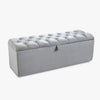
Bedroom Pouffe or Ottoman Storage Box: Which Should You Choose?
, by RSB Furniture, 8 min reading time
, by RSB Furniture, 8 min reading time
A practical guide to choosing between a bedroom pouffe and an ottoman storage box by comparing function, footprint, storage access, upholstery and placement.
A bedroom pouffe and an ottoman storage box can occupy a similar place in a room, but they do not necessarily solve the same problem. One may prioritise a broad upholstered surface and occasional seating, while another combines a cushioned top with concealed storage. Choosing well starts with deciding what the piece must do every day.
This guide compares the practical roles of a bedroom pouffe and an ottoman storage box using current RSB Furniture products as examples. It covers function, footprint, storage access, upholstery and placement so you can make a room-specific choice without assuming that every upholstered ottoman has the same construction.
Write down your main requirement before comparing colours or button patterns. If you want a generous upholstered surface at the foot of the bed, a place to rest your feet or occasional extra seating, a pouffe may be the closer match. If the room needs a home for spare bedding or other bedroom items, a storage box gives the furniture a second, concealed function.
Avoid choosing on the word “ottoman” alone. Retailers and shoppers may use that term for upholstered footstools, benches and storage boxes, so the product description matters more than the label. Check whether the exact item lists a storage compartment, how it opens, what size it is and whether the top is described for seating.
The active Lux Pouffe is listed as a 100 cm by 100 cm piece with a height of 40 cm. Its current description specifies velvet upholstery, deep button tufting, multiple colour options and possible use as a footstool, ottoman or extra seating. It does not describe a concealed compartment, so it suits a brief centred on surface area and upholstered presence rather than hidden storage.
The Vianca Ottoman Storage Box has a different purpose. Its current product information describes space for blankets, pillows, toys and other items, together with a soft cushioned top that can provide seating. This makes it relevant when you want one piece to hold bedroom items and offer a usable top.
The active Secret Hideaway Ottoman Box also combines seating and storage. RSB’s product record describes a hidden compartment, velvet upholstery and a hinged lid that stays open for access. These details are useful if storage access is central to your decision, but the live product page should still be checked before ordering.
| Decision point | Bedroom pouffe | Ottoman storage box |
|---|---|---|
| Main purpose | Upholstered surface, footrest or occasional seating | Concealed storage with a cushioned top on the RSB examples |
| Storage | Do not assume it is included; The Lux Pouffe does not list a compartment | Check the listed compartment and the items the product is designed to hold |
| Opening space | No storage lid to plan around when the product has no compartment | Allow usable access to the lid and check the exact opening method |
| Visual weight | Can act as a broad upholstered feature | Often reads as a bench-like box; shape and upholstery vary by product |
| Best first question | Do I need a surface or extra seat more than storage? | What needs to be stored, and can I open the box easily in this position? |
Measure the intended gap in centimetres and compare it with the complete dimensions of the exact product. The Lux Pouffe’s listed 100 cm square footprint, for example, needs to be planned as a substantial piece rather than as a narrow bench. Do not estimate from a styled photograph, because camera angle and the size of the surrounding bed can make furniture appear smaller or larger.
If the piece will sit at the foot of the bed, include the bed frame and any footboard in the same floor plan. Mark the furniture outline with removable tape or sheets of paper, then test the route to the door, wardrobe and both sides of the bed. The related guide to planning space at the foot of a bed explains why the finished frame and everyday routes should be considered together.
Repeat the check with wardrobe doors, drawers and the bedroom door open. A piece can fit the empty floor area while still interrupting another item when that item is in use.
A storage box only helps when you can reach and open it conveniently. Consider the lid’s movement, the space needed to stand beside the box and any nearby bedding, curtains or furniture. The Secret Hideaway description specifically lists a hinged lid that stays open, while the Vianca description does not state an opening mechanism. Check the current photographs and product details rather than transferring one product’s mechanism to another.
Think about what will go inside and how often you need it. RSB lists blankets, pillows and toys among the possible contents for the Vianca, while the Secret Hideaway record also mentions books. Frequently used items are easier to manage when the box can be opened without first moving lamps, laundry baskets or other furniture.
Storage capacity is not stated in the current records for these examples, so avoid judging it from the outer shape alone. If a particular item must fit, confirm the relevant internal measurements with RSB Furniture before ordering.
The top surface affects both appearance and use. The Lux Pouffe has button tufting across a broad square top. The Vianca is described with a cushioned top, and the Secret Hideaway has velvet upholstery and a seating function. Compare those details with the way you expect to use the piece rather than treating every upholstered top as identical.
Colour and texture should also relate to the bed, flooring, curtains and other permanent elements. An exact match is not required, but a repeated tone or compatible texture can make the arrangement feel intentional. For a broader room scheme, the guide to styling a bedroom around an upholstered bed shows how to keep one main focal point and use surrounding pieces as supporting elements.
Check the live colour choices for the product you intend to buy. The Lux Pouffe currently lists multiple colour options, while options can differ between products and can change over time.
A large pouffe can work when the room has enough floor area and you want the upholstery to make a visible statement. A long storage box can be more appropriate when bedding needs a dedicated home and the lid remains easy to reach. In a tighter room, the right answer may be to leave the space open rather than forcing in another item.
Consider the view from the doorway as well as the plan from above. A low upholstered piece can repeat the bed’s fabric and buttoning, but it should not hide the bed’s foot-end detail if that feature is important to the design. If the room already includes a strong headboard, patterned flooring or several upholstered items, a simpler surrounding arrangement may create better visual balance.
Choose the Lux Pouffe when a 100 cm square upholstered surface, footrest or occasional seat matches the available space and concealed storage is not the priority. Compare the Vianca when you want a cushioned top and storage for items such as blankets or pillows. Consider the Secret Hideaway when a velvet storage box with a specified stay-open hinged lid better fits the way you want to access the contents.
These are product-specific distinctions, not rules for every pouffe or ottoman. Confirm the current description, images, dimensions, upholstery and ordering options for the exact item before making a decision.
The useful choice is the one that answers a real room need. Start with function, verify the product-specific details and test the full outline in the bedroom before choosing between a pouffe and an ottoman storage box.


