

Under-Bed Storage or a Separate Blanket Box for Spare Bedding?
, by RSB Furniture, 8 min reading time
, by RSB Furniture, 8 min reading time
Decide whether spare bedding is easier to keep beneath an ottoman bed or in a separate blanket box by considering how often you need it, opening access, room location and future flexibility.
Spare bedding needs a home, but the best place is not always the largest-looking compartment. A duvet used only when guests visit presents a different storage problem from a blanket reached for every few evenings. You could keep either beneath an ottoman bed or in a separate blanket box; the better choice depends on the journey from storage to use, not just the amount of floor space available.
Start by identifying the exact bedding you want to put away and the room where it will be needed. Then consider how often you retrieve it, what must move before you can open the storage and whether you might want to relocate the container later. The two current RSB Furniture examples below illustrate those decisions, but their specifications should not be treated as interchangeable.
List the spare duvet, pillows, throws or bed linen you plan to store. Beside each item, write how often you actually take it out and where you use it. If a duvet comes out twice a year for visitors sleeping in the bedroom, putting it beneath that bed may be logical. If a throw is used in the living room most evenings, having to go upstairs and open the bed every time may be less appealing than keeping a box nearer the sofa.
Now rehearse the whole action rather than focusing only on the opening mechanism: walk to the furniture, make room to open it, lift out the bedding and put everything back afterwards. Consider the same sequence when you are carrying an armful of freshly washed linen. The easiest storage location is the one you will still use when the room is in its ordinary, occupied state, not just when it is perfectly tidy.
Frequency is not an automatic verdict. An occasional-use duvet might belong in a separate box if visitors sleep in another room; a frequently changed sheet set might be convenient under the bed if that is where the laundry is sorted. Let the actual route decide.
The active Sleek Panel Divan Ottoman Bed is described with a hidden under-bed storage compartment. RSB says its assisted gas-lift mechanism lifts the mattress platform to reveal space intended for items including spare bedding, pillows, towels, shoes and seasonal clothing. Its tall upholstered headboard and matching vertical panel detail are design features, but the important point here is that access is through the bed itself.
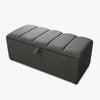
By contrast, the Flavio Panel Ottoman Blanket Box is an independent piece described as holding blankets, cushions or toys. Its product description specifies built-in hinges so the lid opens and closes smoothly, together with a cushioned top. Reaching its contents involves opening that lid rather than lifting a mattress platform. RSB does not say in the supplied description that the lid stays open by itself; check the live product details if that matters to your use.
Neither opening should be assumed to work identically on every ottoman product. The bed description explicitly identifies assisted gas lift; the Flavio description identifies hinges, not a gas-lift mechanism. Nor do these descriptions provide the internal measurements needed to promise that a particular folded duvet will fit. Confirm the exact storage specification and usable internal space before buying for a specific item.
For storage beneath a bed, picture the bed made up as usual. Can you comfortably reach the opening and lift the platform in its intended position? Will a nearby wall, bedside furniture or the normal route around the bed make the action awkward? If you expect to retrieve bedding while someone is resting on the bed, think about whether a different location is more practical for your household. Do not assume that a product photograph proves the opening will be convenient in your room.
For a separate box, mark its intended footprint on the floor and allow for the lid to open. Try standing in the position from which you would take out a folded duvet. A box at the foot of the bed might put bedding conveniently close, yet it may also affect the route past the bed or access to a wardrobe. A box against a wall may seem discreet until you discover that another piece of furniture obstructs its lid.
RSB's guide to choosing between a bedroom pouffe and an ottoman storage box explores the separate question of whether you need a footrest or concealed storage at all. Here, assume that storage is necessary and test which of the two locations makes access simpler for your particular bedding.
Under-bed storage keeps the bedding and the bed together without introducing another standalone furniture piece. That may suit a bedroom where the spare set belongs to the same mattress. It can also keep the floor available for walking, provided you are happy with the way the bed opens in that layout.
A blanket box can put bedding in a different part of the bedroom or potentially in another room. The Flavio description itself presents it as a living-room storage piece as well as a place for blankets and cushions. If a throw is used beside the sofa, that proximity may be the deciding advantage. If guests use a spare room, consider whether bedding needs to live near their sleeping area instead of under the main bed. The item should still suit the intended room's dimensions and everyday circulation.
Think beyond the storage position to the return trip. Where will you stand to fold the item, and how far will you carry it when replacing it? A location that saves a short walk on retrieval but leaves no convenient place to fold or sort linen may be less helpful than it first appears.
An ottoman storage bed combines a sleeping place and a storage location. Once the bed's position is chosen, its compartment remains tied to that position unless the bed itself is moved. This may be exactly what you want for bedding dedicated to that room. It may be less flexible when a spare room changes purpose or when throws circulate between rooms.
A separate box offers a different planning option: you can reconsider where that piece belongs without changing the bed. That does not mean it will always be easy to move. Check its actual dimensions, weight, construction and the route between rooms before assuming you can shift it regularly. Treat relocatability as a potential advantage to verify, not a specification guaranteed by the product name.
There is also a mixed approach. Reserve the bed compartment for infrequently needed bedding associated with that bed, and keep a commonly used blanket closer to the room where it is used. Only add a second furniture piece if the access benefit justifies its footprint; you need not fill both storage locations simply because they are available.
If you are still deciding what kind of storage bed you need, RSB's article on divan and ottoman bed options addresses that wider bed-style choice. The narrower decision here is where the same bedding should live: inside the bed you already plan to use, or in a lid-opening piece that can occupy another suitable spot.
Choose under-bed storage when the bedding belongs with that bed, you do not need it in another room and lifting the platform will fit your routine. Favour a separate blanket box when the item is used elsewhere, a lid is easier for you to reach in the planned position or you value the option to reconsider the box's location later. If neither opening can be used comfortably in your actual layout, revisit the furniture position before purchasing.
Finally, return to the live RSB pages for the exact bed or box. Confirm its stated opening method, current options and measurements rather than inferring capacity from photographs or borrowing details from another product. The most useful storage is not merely hidden; it is accessible at the moment you need that spare bedding.


