

An Upholstered Storage Box in the Hallway or Living Room: What to Check
, by RSB Furniture, 8 min reading time
, by RSB Furniture, 8 min reading time
A room-first guide to placing an upholstered storage box in a hallway or living room, with checks for door swing, circulation, lid access, contents, measurements and product-specific stated uses.
Outside the bedroom, an upholstered storage box's position matters as much as its appearance. A hallway box has to coexist with the front door and the route through the house; a living-room box has to work around sofas, chairs and the way people use the room. In both places, the compartment is only convenient if you can reach it without rearranging everything nearby.
This guide starts with the room rather than the furniture label. Two current RSB Furniture boxes illustrate why you should check each product's stated use, dimensions and opening requirements individually.
Begin with the items that need a home. In a hallway, you might want to put away small accessories used when leaving the house; in a living room, spare throws or cushions may be the more natural contents. These are possible plans for your space, not a promise that a particular item will fit inside a particular box. If you have a bulky object in mind, its measurements matter more than a photograph of an apparently roomy compartment.
Then consider whether the top has a second job. Do you want a place to sit while getting ready to leave, an occasional footrest beside a sofa, or simply concealed storage? Those uses must be checked against the exact product description. An upholstered lid does not, on its own, establish that a box is described as seating. Equally, a product called an ottoman may not have the opening arrangement you expect.
| Position | Test before choosing | Likely storage question |
|---|---|---|
| Hallway or entryway | Can the entrance and nearby internal doors move as they do now, with the box in place? | Can you access frequently used contents without blocking the route? |
| Living room | Can people still move between the seating, doorway and other furniture? | Can the top be cleared and the compartment opened when you need a throw or cushion? |
Measure the wall or alcove where the box might sit, but do not stop at the empty wall width. Open the front door fully and trace the area its edge travels through. Do the same for any cupboard or room door near the proposed position. A box can fit along the skirting board yet fall in the door's path, or leave so little standing room that retrieving its contents is awkward.
Think through an ordinary arrival. Where do you stand to close the door? Which way do you turn to reach the next room? Is there a bag, shoe rack or other furniture already claiming part of that route? Mark the proposed box outline with paper or low-tack tape, and walk through the entrance with the doors in their usual positions. If the outline narrows a busy spot, try another stretch of wall or a different piece rather than treating every centimetre of wall as usable storage space.
Also rehearse the moment you actually need the contents. If the box would be tucked behind an open door, you may have to close that door before lifting the lid. That may be perfectly acceptable for infrequently used items, but less convenient if you expect to open the box each time you leave. The right hallway position is one that works both closed and in use.
A living-room box can sit beside a seating group or against an available wall, but those positions create different demands. Near a sofa, check the route around the furniture while someone is seated, rather than measuring the box against an empty floor. Against a wall, check whether you can stand where the lid needs to open. A coffee table, side chair or rug edge can change how easily you reach the compartment even when the box itself fits.
Work through a small routine: enter the room, pass the proposed position, sit down, then get up to retrieve something from inside. If the top is likely to accumulate books, cushions or other objects, decide where they would go before each opening. Concealed storage is less useful when using it first means clearing a surface and shifting adjacent furniture. Leave breathing room for both the person opening the box and the lid's movement; do not infer an opening direction or hinge specification from a styled image.
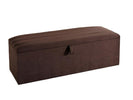
The Victorian Vintage Ottoman Box is described by RSB as having a hidden compartment for blankets, pillows, toys or other items. Its description explicitly mentions the living room and entryway as possible rooms, as well as the bedroom. It also states that its soft-fabric upholstered top can be used as a comfortable seat. If hallway seating is central to your plan, that statement is a relevant starting point; still check the current item details and your chosen configuration before relying on it for a particular use.
The Velvet Vault ottoman box is described differently: RSB lists a plush velvet exterior, hidden storage for blankets, pillows or other belongings, and use as a storage ottoman or footrest. Its product description does not explicitly call it a seat. For a living-room plan centred on a footrest and nearby storage, that distinction may be useful. Do not transfer the Victorian box's stated seating use to the Velvet Vault simply because both have upholstered tops.
Neither product description gives complete external width, depth and height, internal compartment dimensions or a specified lid-opening mechanism. Ask RSB for the external and internal dimensions you need, and for how the selected lid opens, before designing a tight fit or deciding what will go inside. Check the live page again when selecting upholstery or other options.
List the objects you intend to store, their approximate bulk and how often you would take them out. In the entrance, regularly used things favour a position you can reach without stepping around the open door. In the living room, a box intended for spare throws may be easier to use near the seating than in a distant corner, provided the lid still has room to move. These are placement choices, not product capacity claims.
Measure the largest intended item and compare it with confirmed internal dimensions, rather than just the box's outside footprint. Think about how you will lift the item in and out: a compartment might be large enough for an object while its opening is inconvenient in a restricted position. The product descriptions call the compartments spacious but do not provide a capacity figure, so leave the final fit decision until the measurements and opening details have been confirmed.
Pay particular attention to the space above and beside the top. It is easy to mark a closed box on a floor plan and forget that a lid has to travel somewhere. Wall decor, a shelf, curtains or furniture immediately adjacent to the box may make access less comfortable. Check the chosen model's opening arrangement instead of assuming its lid will stay up, open from a particular side or behave like another RSB product.
In a bedroom, the question is often whether a piece sits at the foot of a bed, works with the bed's upholstery or provides storage for spare bedding. RSB's bedroom pouffe and ottoman comparison addresses that different choice: a broad upholstered surface versus a storage box in a bedroom layout. It is not a substitute for checking an entrance door swing or a living-room circulation route.
Appearance still matters, but let it follow the room plan. The Victorian box's description presents it as Victorian-inspired, while the Velvet Vault is specified with velvet upholstery. Consider how either piece relates to the existing sofa, flooring and other visible fabrics without assuming the picture shows every available finish. If you are furnishing a bedroom instead, the separate guide to styling around an upholstered bed is the more relevant starting point for that room's focal point.
Before deciding, mark the verified exterior footprint of your chosen configuration where the box would stand. Try the arrangement at the time you would normally use it: open each nearby door, move between furniture and mimic reaching into the box. If a top is intended for sitting or use as a footrest, return to that exact product's stated uses rather than a general idea of what an ottoman does.
A hallway box earns its place when it does not disrupt the way you enter and leave; a living-room box earns its place when it supports rather than interrupts the seating area. Choose the position and the model together, and treat measurements and stated uses as product-specific details to verify before ordering.


